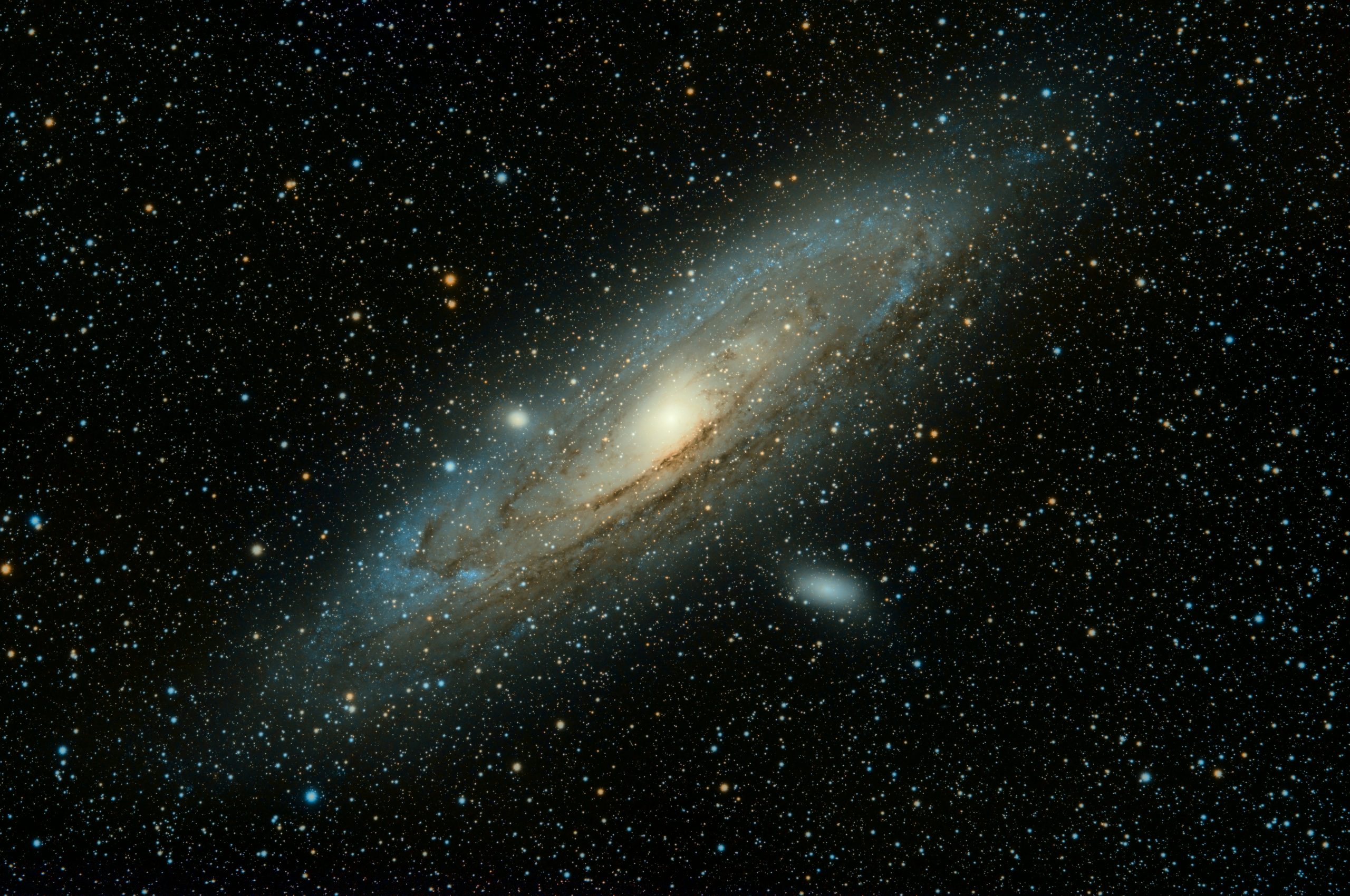
Astronomers have confirmed thousands of planets orbiting stars in our own galaxy. But every one of them lives in the Milky Way’s neighborhood. The next frontier is far harder and far more thrilling: finding planets in other galaxies, millions or even billions of light-years away. A handful of tantalizing candidates suggest it may already be happening.
Why It’s So Hard
Most exoplanets are found by watching a star dim slightly as a planet crosses in front of it, or by detecting the tiny wobble a planet causes in its star’s motion. Both methods need a clear, bright view of an individual star. In another galaxy, individual stars blur together into a glowing smear, and any planet’s signal is vanishingly faint. Spotting a planet there is like trying to see a firefly beside a floodlight from across an ocean.
That is why researchers have had to get creative, using methods that don’t depend on seeing the planet’s own light at all.
Candidate 1: A Planet in the Whirlpool Galaxy
In 2021, a team led by astrophysicist Rosanne Di Stefano at the Harvard & Smithsonian Center for Astrophysics reported what may be the first planet found outside the Milky Way. Using NASA’s Chandra X-ray Observatory, they studied an X-ray binary called M51-ULS-1 in the Whirlpool Galaxy, roughly 28 million light-years away.
An X-ray binary pairs a dense neutron star or black hole with a companion star whose material it pulls away, creating a small, intensely bright source of X-rays. Because that bright region is so compact, a planet passing in front of it can block most or all of the signal, making a transit unusually easy to detect. The team saw exactly that kind of dip, consistent with a planet roughly the size of Saturn.
The catch: the candidate’s orbit is so wide that it would not cross in front of its partners again for about 70 years, so confirmation will take decades. If real, the planet would also have survived the violent supernova that created its compact companion, which makes it a fascinating puzzle in itself.
Candidate 2: Microlensing in Distant Galaxies
A second technique uses gravity itself as a lens. When a star or planet passes in front of a more distant light source, its gravity bends and briefly magnifies that light. Planets leave subtle fingerprints in these brightening events, even when the planet is far too faint to see.
Researchers have applied this idea twice. In 2009, an Italian-led team reported a possible companion to a star in the Andromeda galaxy, with a mass several times that of Jupiter. In 2018, University of Oklahoma astronomers Xinyu Dai and Eduardo Guerras analyzed a quasar’s light bent by a galaxy about 3.8 billion light-years away and argued the data point to a population of planets there, ranging from roughly Moon-sized to Jupiter-sized. Many scientists regard such results as promising but still needing independent verification.
Planets That Arrived From Elsewhere
There is also a nearer-to-home twist. Some stars in the Milky Way’s outer halo are thought to have originated in smaller galaxies that our galaxy absorbed long ago. A 2022 study searched more than a thousand such stars using data from NASA’s TESS mission and the Gaia survey. No planets turned up, but the work set a useful upper limit and suggested that thousands more stars would need to be searched before a planet of extragalactic origin is likely to appear.
What Comes Next
New tools are changing the odds. Machine-learning pipelines are already being trained to sift through archives of X-ray data for transit-like dips that humans might miss. Upcoming wide-field surveys and next-generation observatories will monitor enormous numbers of stars and distant lensing events, creating more chances to catch a rare signal.
Even so, extragalactic planets will likely remain candidates rather than certainties for some time, since confirming them demands patience, repeated observations, or independent methods.
Why It Matters
Planet formation might look different in other galactic environments, including regions with different chemical makeup, more violent radiation, or very different star populations. Finding even a few planets elsewhere would help answer one of astronomy’s biggest questions: whether the planetary systems we see around us are typical of the universe, or just one local version of it.
For now, the search is a reminder that in science, the biggest discoveries often begin with a faint, uncertain dip in the data and the curiosity to ask what might be causing it.